
NEW
1:34
Maintaining consistent weld quality can be a challenge when joint fit-up conditions vary from part to part. In this Tech Short, we will explore FANUC ArcTool's Adaptive Welding functionality and how it works with third-party laser seam tracking sensors to automatically adjust welding parameters based on real-time joint measurements.
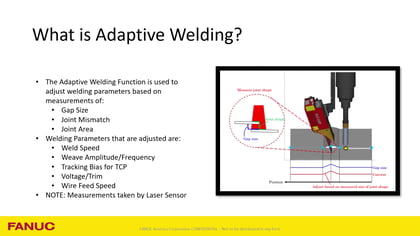
Adaptive welding is designed to help robotic welding applications respond to changing gap sizes, joint mismatch, and weld joint geometry. Rather than relying on a single set of programmed welding parameters, this technology uses data collected by a laser seam tracking sensor to dynamically modify the welding process as conditions change. The result is improved weld consistency, better volumetric fill, and more effective handling of part variation.
Throughout this session, we will review the software requirements, hardware components, and sensor integration needed to support adaptive welding on FANUC robotic welding systems. We will also examine how the technology can be applied to common weld joint types, including butt joints, V-groove joints, bevel joints, fillet joints, and lap joints.
Whether you are evaluating seam tracking technologies, looking to improve weld quality, or seeking ways to automate adjustments traditionally made by skilled operators, this overview provides a practical introduction to adaptive welding and its role in modern robotic welding applications.
Requirements
To implement adaptive welding, the following components are required:
What You'll Learn
Learn how adaptive welding enables FANUC robotic welding systems to adapt to real-world manufacturing variation while helping improve weld quality, process consistency, and production efficiency. Register to watch the full Tech Short and see how sensor-driven welding adjustments can enhance your robotic welding applications.


