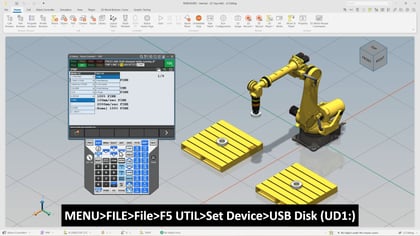
How Termination Type Affects Robot Path and Cycle Time
Explore FANUC robot termination types and see how fine, CNT, CR, and CD settings affect path accuracy, corner rounding, and cycle time.
Adam explores the concept of passing arguments in ROBOGUIDE programs, emphasizing modularity. The video demonstrates this by creating both primary and secondary dummy programs. Through these examples, Adam clarifies the purpose and structure of arguments, along with the application of logical statements like if-then conditions. A key focus is on how arguments are seamlessly transferred from the primary program to the secondary, leveraging registers for enhanced modularity. This method not only streamlines programming but also unlocks additional functionality and flexibility within robotic applications, making the code more organized and reusable.
Explore FANUC robot termination types and see how fine, CNT, CR, and CD settings affect path accuracy, corner rounding, and cycle time.
Learn how FANUC user frames simplify robot programming, enable quick recovery, and improve accuracy by aligning motions to fixtures.
Learn how to teach a coordinated pair with a single axis positioner, covering setup, calibration, and validation for FANUC robots.
Learn how to teach a coordinated pair with a two-axis positioner using FANUC robotics. Step-by-step setup, calibration, and verification.
Discover how mixed logic simplifies IO control and boosts automation efficiency. Learn autoexec programs, background logic, and markers.
Discover FANUC’s Servo Gun Diagnosis Package and learn how predictive maintenance improves weld gun health, reliability, and performance.