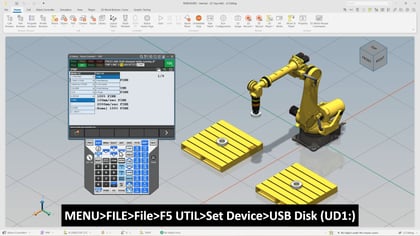
How Termination Type Affects Robot Path and Cycle Time
Explore FANUC robot termination types and see how fine, CNT, CR, and CD settings affect path accuracy, corner rounding, and cycle time.
This video introduces the debate between joint and cartesian representation of robot positioning, emphasizing that the robot itself doesn't care about the representation but is a tool for the programmer's convenience. It explains the details of joint representation, including the active tool frame and manipulation using a joint jogging tool. World representation is discussed in terms of the tool tip's position relative to the robot's base, and user representation is explained in terms of defining specific points in space for the robot. The text also covers the benefits of joint representation, the use of joint commands, and the importance of manipulating the robot's motion for specific applications. Overall, the debate between joint and cartesian representation is presented as a means to bring clarity to robot positioning and aid programmers in their work.
Explore FANUC robot termination types and see how fine, CNT, CR, and CD settings affect path accuracy, corner rounding, and cycle time.
Learn how FANUC user frames simplify robot programming, enable quick recovery, and improve accuracy by aligning motions to fixtures.
Learn how to teach a coordinated pair with a single axis positioner, covering setup, calibration, and validation for FANUC robots.
Learn how to teach a coordinated pair with a two-axis positioner using FANUC robotics. Step-by-step setup, calibration, and verification.
Discover how mixed logic simplifies IO control and boosts automation efficiency. Learn autoexec programs, background logic, and markers.
Discover FANUC’s Servo Gun Diagnosis Package and learn how predictive maintenance improves weld gun health, reliability, and performance.