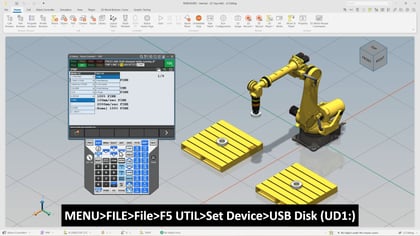
How Termination Type Affects Robot Path and Cycle Time
Explore FANUC robot termination types and see how fine, CNT, CR, and CD settings affect path accuracy, corner rounding, and cycle time.
Adam introduces the topic of strings in FANUC, highlighting two predominant ways to use strings: outputting status to a human and writing modular code. They explain that robots don't care about ascii strings, only operators, programmers, and users do. Accessing string registers in FANUC is discussed, with the default number of string registers being 25, expandable to hundreds in controlled start mode. The scenario of the robot communicating with an HMI to provide status updates is presented, along with setting up string registers for status updates and using strings to call programs modularly. The video concludes with encouragement to have fun coding and share how strings are being used, emphasizing that strings are methods to make life easier for the operator.
Explore FANUC robot termination types and see how fine, CNT, CR, and CD settings affect path accuracy, corner rounding, and cycle time.
Learn how FANUC user frames simplify robot programming, enable quick recovery, and improve accuracy by aligning motions to fixtures.
Learn how to teach a coordinated pair with a single axis positioner, covering setup, calibration, and validation for FANUC robots.
Learn how to teach a coordinated pair with a two-axis positioner using FANUC robotics. Step-by-step setup, calibration, and verification.
Discover how mixed logic simplifies IO control and boosts automation efficiency. Learn autoexec programs, background logic, and markers.
Discover FANUC’s Servo Gun Diagnosis Package and learn how predictive maintenance improves weld gun health, reliability, and performance.