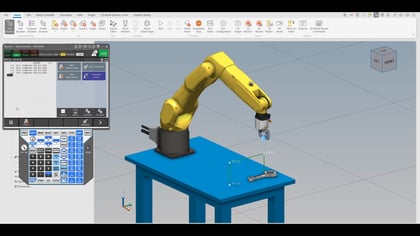
How Termination Type Affects Robot Path and Cycle Time
Explore FANUC robot termination types and see how fine, CNT, CR, and CD settings affect path accuracy, corner rounding, and cycle time.
Singularity in robotics can cause problems for robot programmers and operators, occurring when a robot has an infinite number of kinematic possibilities to reach the same end position. This can lead to the robot faulting out if it cannot decide which solution to take. FANUC offers a tool called Singularity avoidance, which provides built-in intelligence to the robot to force a specific solution and prevent singularity. Singularity occurs in six-axis or more robots, especially when J5 is at zero, and it can happen in various positions in the robot's workspace. Possible solutions to fix singularity include physically relocating the robot, changing the conveyor or pick-place locations, and experimenting with moving the tooling. Planning ahead and designing around singularity in the initial stages can also prevent singularity issues.
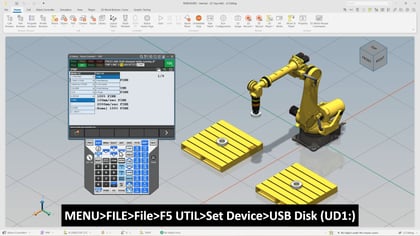
Explore FANUC robot termination types and see how fine, CNT, CR, and CD settings affect path accuracy, corner rounding, and cycle time.
Learn how FANUC user frames simplify robot programming, enable quick recovery, and improve accuracy by aligning motions to fixtures.
Learn how to teach a coordinated pair with a single axis positioner, covering setup, calibration, and validation for FANUC robots.
Learn how Intelligent Interference Check for ARC protects robots, tooling, and fixtures using modeled geometry and real-time collision prevention.
Learn how to teach a coordinated pair with a two-axis positioner using FANUC robotics. Step-by-step setup, calibration, and verification.
Learn how to set accurate UTOOL offsets for custom grippers in PalletTool 3, including X, Y, Z, and R values for multi-zone setups.