NEW
5:22

In this Tech Transfer Short, we will go over the fundamentals of user frames and why they play a critical role in efficient robot programming and long term process maintenance. Whether you are new to FANUC robots or looking to strengthen your foundation, this video provides a clear overview of how user frames help bring structure and flexibility to your applications.
We start by defining what a user frame is and how it relates to the robot’s world frame. From there, we explain how user frames act as local Cartesian coordinate systems that assign a reference point and orientation to a fixture or workpiece. This concept becomes essential when working with multiple fixtures, changing tooling, or maintaining programs over time.
Throughout the video, we will go over why applications benefit from using user frames instead of relying solely on the world frame. We discuss how programming relative to a user frame makes points easier to teach, adjust, and reuse. When fixtures are resurfaced, moved, or replaced, user frames allow us to update the entire program by simply reteaching the frame rather than editing every individual point. This approach significantly reduces downtime and simplifies recovery.
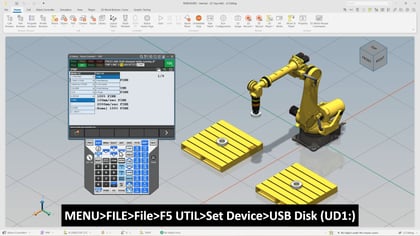
We also touch on how jogging with an active user frame aligns the robot motion to the part instead of the world, making teaching more intuitive and reducing the risk of errors. A visual example is used to show how a user frame is established using an origin and directional references, and how retouching that frame can shift all associated points as long as the robot remains within its work envelope.
This video sets the stage for more advanced topics by establishing a strong conceptual understanding of user frames and their practical benefits in real world applications.
Requirements:
What You Will Learn:
If you want to build more robust robot programs and reduce the effort required to maintain them, this video is a great place to start. Sign up to watch and continue into the next video, where we will go over how to teach, apply, and recover user frames in practice.