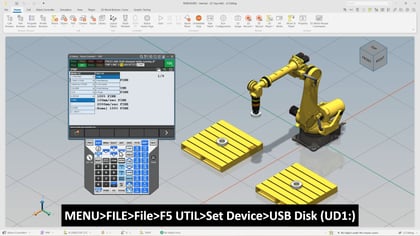
How to Remote Start a Robot using the OTHER Method (Part 2)
Part 2 of a series; learn to utilize the User Operator Panel Inputs and Outputs (UOP I/O) to control the robot remotely (ex: from a PLC).
In this video, Application Engineer Katie Austin explains the key differences between the teach pendant's Quick Menu and Full Menu states. She clarifies what to look for when identifying each state, such as the distinct 'MENU 1' or 'QUICK 1' header. Through a side-by-side comparison, Katie highlights how the Quick Menu simplifies the interface by removing many sub-menu items and soft-key options from screens like I/O, Select, and Edit. She also demonstrates the simple process of toggling between the two states and reveals that different screens in a split-screen display can be set to different menu states. This video will help both new and seasoned programmers confidently navigate their programming endeavors.
Part 2 of a series; learn to utilize the User Operator Panel Inputs and Outputs (UOP I/O) to control the robot remotely (ex: from a PLC).
Part 1 of a series; learn to utilize the User Operator Panel Inputs and Outputs (UOP I/O) to control the robot remotely (ex: from a PLC).
Boost automation with Python on FANUC R-50iA controllers. Learn script execution, data handling, and integration tips for robotics workflows.
Set up and use Python remote debugging on FANUC R-50iA controllers with VS Code for efficient script development and troubleshooting.
Learn how to set up a photoelectric sensor for FANUC’s S627 TCP calibration, including wiring, IO config, and teach pendant setupÂ
How to route cables and hoses from the J3 arm connections to the End of Arm Tooling on the unique LR Mate/25 series (formerly known as M-20iB series).